

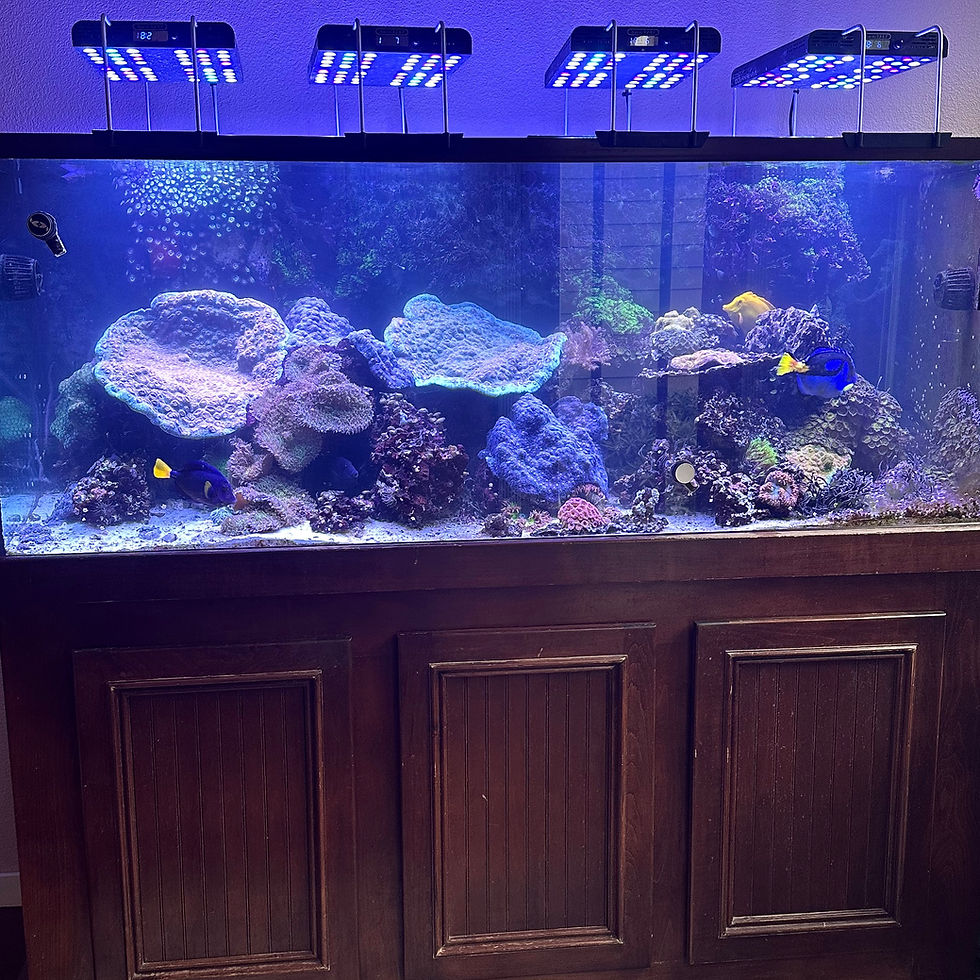
What It Really Takes to Install a Large Aquarium in an Existing Home
Updated: Sep 26
Most people picture aquarium installation like furniture delivery: a couple of guys carry in a box, set it down, done.
A large aquarium is not furniture.
A 300-gallon glass tank can weigh close to 1,000 pounds empty. It doesn't bend around corners, it doesn't forgive a dropped edge, and one bad lift can crack a panel worth thousands of dollars — or injure someone permanently. Installing one in an existing home is closer to a construction project, and I want to pull back the curtain on what that actually looks like.
First, we protect your house from us
Before the tank moves an inch, the house gets armored. Floors get heavy-duty sheeting and hardboard on the entire carry path. Stair treads get covered and edged. Door frames and wall corners get padding. Banisters — the natural handhold everyone grabs when carrying something heavy up stairs, get wrapped or removed.
This isn't paranoia. A thousand pounds of glass with momentum behind it will go through drywall like paper and gouge hardwood down to the subfloor. The protection takes real time, and skipping it is how "free installation" from a discount seller turns into a $5,000 floor repair.
The lift: suction cups and choreography
Tanks this size move by hand, with industrial suction clamps rated for the load and a team of up to eight men. Everyone has a position, a grip, and a job. We walk the route empty-handed first by measuring every doorway, every turn, every stair because once eight men are carrying 1,000 pounds of glass, there are no improvisations.
It looks slow from the outside. That's the point. Slow is smooth, and smooth is safe. The team moves as one unit, on calls, with spotters watching clearances the carriers can't see.
When muscle isn't enough: hydraulic jacks
Some placements defeat carrying altogether setting a tank into a custom in-wall opening, or raising it onto a tall built-in stand with millimeter tolerances. That's when the hydraulic jacks come out.
Jacking a glass aquarium sounds terrifying, and honestly it demands respect. The load has to stay perfectly level as it rises any twist or point load on a glass panel can crack it. We lift in small increments, cribbing as we go, checking level constantly. It's slow, methodical work, and it's the only safe way to land a tank exactly where the design calls for it.
The extreme end: cranes, street permits, and backyards
Then there are the installations where the tank simply cannot go through the house. A 500+ gallon display with no straight path from the street to its final location. A backyard build where the only access is over the roof.
For those, we permit and block the street, bring in a crane company, and fly the aquarium over the house into the backyard then bring it in through double doors. Yes, really. It requires permits, a licensed crane operator, rigging planned around the tank's center of gravity, and coordination down to the minute. I've done it. It's equal parts stressful and spectacular.
Why I'm telling you this
Not to scare you to make a point. The aquarium is the visible part of the project, but the installation is where experience either shows or doesn't. Every one of these scenarios is something I've planned for and executed across 300+ service accounts and 20+ years.
When you hire Fish Doctor for a custom build, the install plan is part of the design from day one: the route survey, the protection, the crew size, the equipment, and yes if your dream tank needs a crane, we'll tell you that at the consultation, not on delivery day.
No surprises. Just a thousand pounds of glass landing exactly where it belongs.
Thinking about a large aquarium?
We offer a free on-site consultation
we'll walk your space, talk through the install realities, and you'll get an itemized estimate for the entire project in 48 hours.
Fish Doctor
(650) 922-7744
Serving San Francisco to Mountain View and Half Moon Bay to Pacifica


Comments